
Online Education’s Leap: How Digital Tools are Remaking Learning
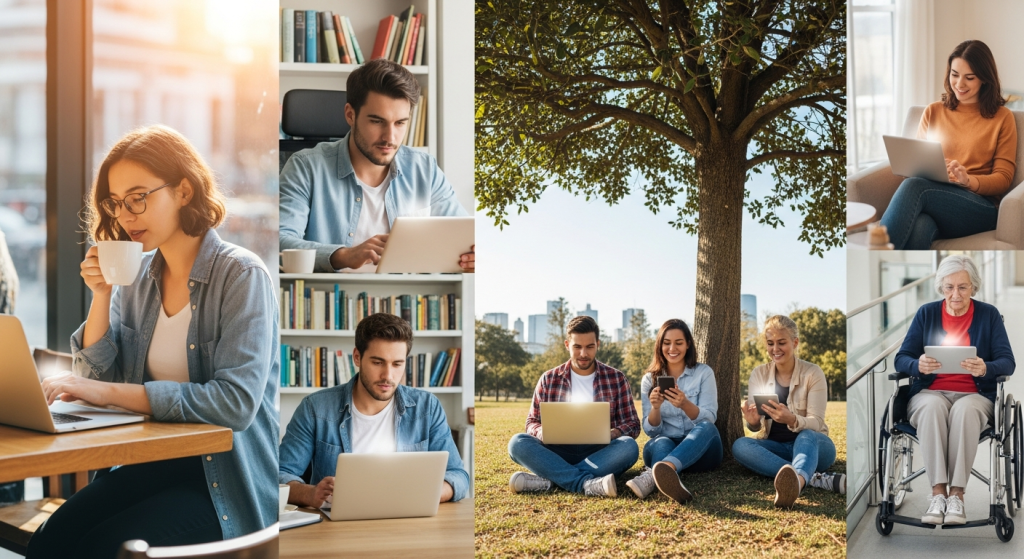
Alt: Students from different demographics and locations engaging in online learning, some focused on laptops, others interacting with tablets, symbolizing the global reach and flexibility of digital education.
Remember when learning meant sitting in a room, maybe even a stuffy one, listening to someone talk? Well, that’s pretty much a relic for a lot of students now. Education, the way we know it, totally changed. The internet didn’t just add a new layer to schooling; it pretty much rewrote the whole playbook.
We are in 2026, and the shift is clear. I’ve witnessed firsthand how this is more than just a trend; it’s become the norm for millions, reshaping everything from primary school to advanced professional development. And honestly? It’s about time we stopped thinking of learning as something confined by four walls and rigid schedules. The world moves too fast for that. Education had to catch up.
Beyond the Classroom Walls: Learning Anywhere, Anytime
The internet just flattened all those old barriers, didn’t it? Geography? Doesn’t matter anymore. You can be in rural Kansas taking a course from a professor in Berlin, or a busy parent in Sydney finally pursuing that engineering degree from a university in London. This kind of flexibility is a huge shift, letting people access world-class instruction without uprooting their lives.
Because not everyone learns at the same pace or on the same schedule, right? Think about it: some people thrive on live virtual discussions, needing that real-time interaction to feel connected. Others? They genuinely need to pause, rewind, re-read, and absorb things on their own time, often late at night after the kids are asleep or during a lunch break at work. Online learning makes that possible.
It lets them fit education into their actual lives, not the other way around. Which is a pretty big deal for people with jobs, families, or just different personal rhythms. I’ve always thought forcing everyone into the same rigid schedule was counterproductive for many, and digital learning finally fixes that.
Personalized Paths and Diverse Tools
This isn’t just about watching recorded lectures. Not anymore. I’ve noticed how sophisticated these platforms have become. Think about systems that literally adapt to you, changing the material, offering different examples, or suggesting supplementary resources based on what you already know or where you’re struggling. It’s like having a tutor who knows your weak spots better than you do, always pushing you exactly where you need it, which is something traditional classrooms often struggle to provide.
And the sheer amount of content available? Go figure. From specialized niche courses you’d never find locally—maybe something on ancient Sumerian poetry, advanced quantum computing, or even bespoke digital art techniques—to virtual science labs that let you experiment with dangerous chemicals without breaking actual glassware or risking explosions. This kind of access is genuinely underrated; it makes learning so much more relevant and engaging for individual students. It’s not just about what’s *available*, but what’s *tailored* to you.
Assessing What You’ve Learned in Digital Spaces
But how do you really know if someone’s learned something when they’re not in front of you? That’s always been the big question, hasn’t it? Turns out, online assessment tools have gotten really sophisticated. We’re moving beyond just multiple-choice quizzes, thankfully, because they only test surface-level recall. Now, we’ve got complex simulations that require problem-solving, project-based assignments that demand application of knowledge, and incredibly detailed peer reviews that teach critical analysis.
There’s even AI proctoring that, while sometimes a little creepy with its eye-tracking and environmental scans, ensures academic integrity pretty well. And for a lot of students, getting ready for these varied, often challenging assessments means needing good resources. Access to Practice test questions and answers can make a real difference, helping you pinpoint exactly where you need to focus your study efforts. You just can’t wing it with some of these digital exams; preparation is everything. It’s not about memorizing facts anymore; it’s about applying knowledge, and the assessments reflect that shift.
What’s Next for Education?
So, what’s next? I’d say probably a lot more hybrid models, blending the best of both worlds—some in-person interaction for community and hands-on work, plenty of online flexibility for individual study. The idea of learning as a one-time event, something you finish by age 22, that’s gone. Lifelong learning isn’t just a nice phrase now; it’s an economic necessity. Online education makes it possible for everyone to keep acquiring new skills, adapting to a constantly changing job market, and staying relevant in professions that evolve yearly.
Educators? Their role isn’t just delivering facts. It’s guiding, facilitating, curating, and mentoring in ways we’re still figuring out. They’re becoming more like personal learning coaches, helping students find their way through a vast, ever-expanding ocean of information. It’s an exciting, if sometimes chaotic, time to be involved in education, and I think we’ve only just scratched the surface of what’s possible.
